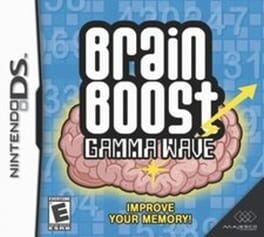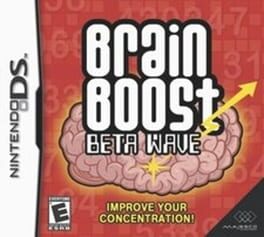
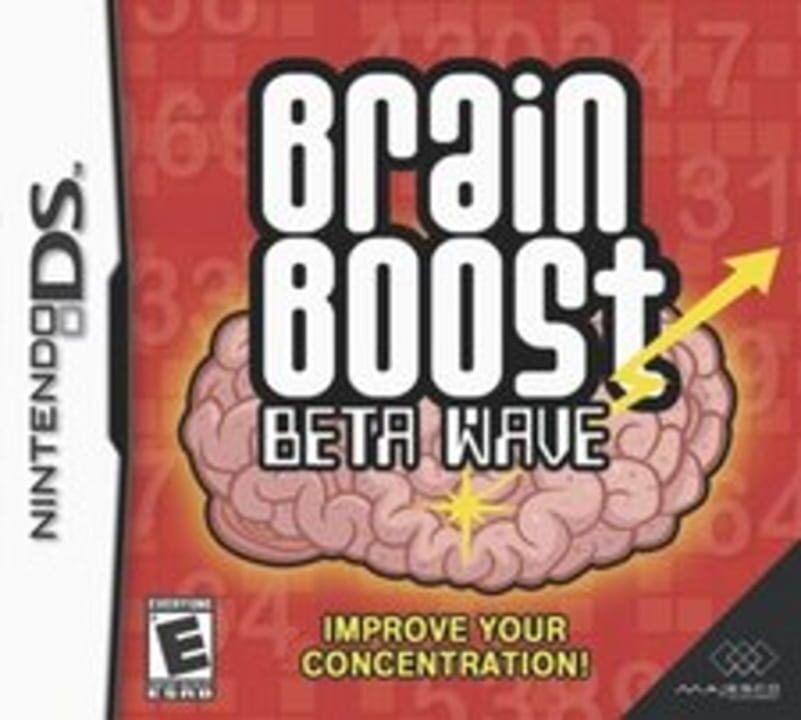
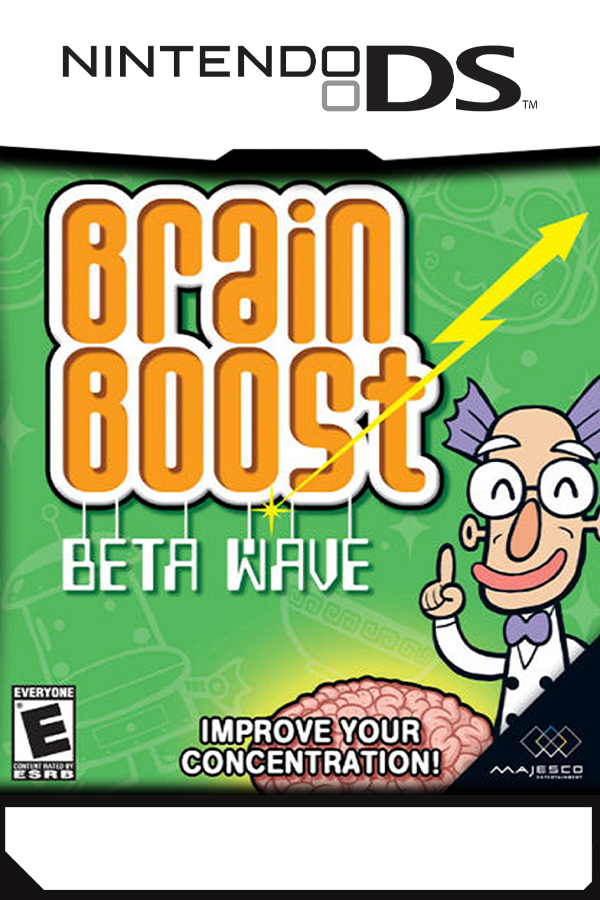
Brain Boost: Beta Wave
Sorti le 15 décembre 2006 sur Nintendo DS sous l'étiquette de l'éditeur 505 Games, Brain Boost: Beta Wave s'inscrit dans le genre de la réflexion en proposant un programme d'entraînement cérébral fondé sur la « théorie du développement du cerveau droit » du chercheur Makoto Shichida. Le postulat du titre repose sur l'idée que les ondes bêta, émises lors de phases de concentration active et de pensée intense, peuvent être stimulées par des exercices ciblés pour développer le potentiel de l'hémisphère droit.
Le logiciel structure son contenu autour de cinq types d'exercices distincts — Recherche de paires, Reconnaissance de formes, Addition, Mémorisation de séquences et Points mobiles — répartis en deux modes de jeu, Entraînement et Défi. Chaque catégorie propose quatre niveaux de difficulté croissante composés de vingt problèmes chacun, présentés sous forme de questions à choix multiples parmi quatre options. La progression est conditionnée par l'atteinte de seuils de réussite fixés à 50 % en mode Entraînement et 60 % en mode Défi, le système de notation récompensant la justesse des réponses ainsi que la rapidité d'exécution via un bonus de temps, permettant ainsi de suivre l'évolution des performances du joueur.
Du côté de la réception critique, les avis se sont montrés partagés. GameSpy a regretté que la décision de scinder le concept en deux titres distincts donne à chacun l'impression d'une démo surévaluée, soulignant que l'ensemble aurait été bien plus pertinent réuni. Game Informer a en revanche conseillé de privilégier cet opus Beta Wave pour son rythme plus soutenu, tout en prévenant les joueurs de la difficulté particulière de l'exercice d'addition.
Médias
Avis des critiques et joueurs
Critiques de la Presse (Metacritic)
« Unfortunately, the decision to split things across two titles makes each game feel like an overpriced demo, proving the old adage that the whole is much greater than the sum of its parts. »
« If you’re going to get one of these, go for the faster-paced Beta Wave, but watch out for that nasty addition game. [Feb. 2007, p.111] »
« The Brain Boost games ride the success of Big Brain Academy and Brain Age, but fail to actually understand why they were successful to begin with. And that's just not smart. »
« The game selection in each is pretty thin at five games, and to top it off none of them are particularly entertaining. Odds are that you’ll just play through them all a couple of times and be done with it. The lack of any kind of detailed feedback or progress tracking means there’s little motivation to keep playing beyond that. »
« Brain Boost feels very thrown together in general. Every aspect of the title, from the graphics to the sound to the storyline, seems poorly done. If you see Brain Boost: Beta Wave on the store shelf, pass it on by - your brain will thank you. »
« But, if you're buying this game because you honestly think it's going to make you smarter, it won't. And if you're buying this game because you actually think it's going to be fun, it isn't. That's really the bottom line. »
« Also disappointing was the lack of any head-to-head or multi-player functionality; there's no unlockable content, either. The games themselves are monotonous and don't really instill you with a need to play them repeatedly. »
« For the price you'll pay for both these games -- which is what you'll need to do if you want a half-decent selection of activities -- you could buy the far superior "Brain Age." Or, for that matter, you could buy just about any of the other genuinely good games on the DS, and pass over this cash-in altogether. »